We are Kings not Humans 2 0 1 5

WE ARE KINGS NOT HUMANS . Direction, choreography Matija Ferlin . Performance Livio Badurina . Ana Begić . Jadranka Đokić . Dušan Gojić . Ivan Jončić . Iva Mihalić . Dramaturgy Jasna Jasna Žmak . Goran Ferčec . Stage design Mauricio Ferlin . Light design Saša Fistrić . Costume design Desanka Janković . Matija Ferlin . Production & partners Kunstfestivaldesarts . Les Brigittines . Croatian National Theatre Zagreb . Matija Ferlin
Read more
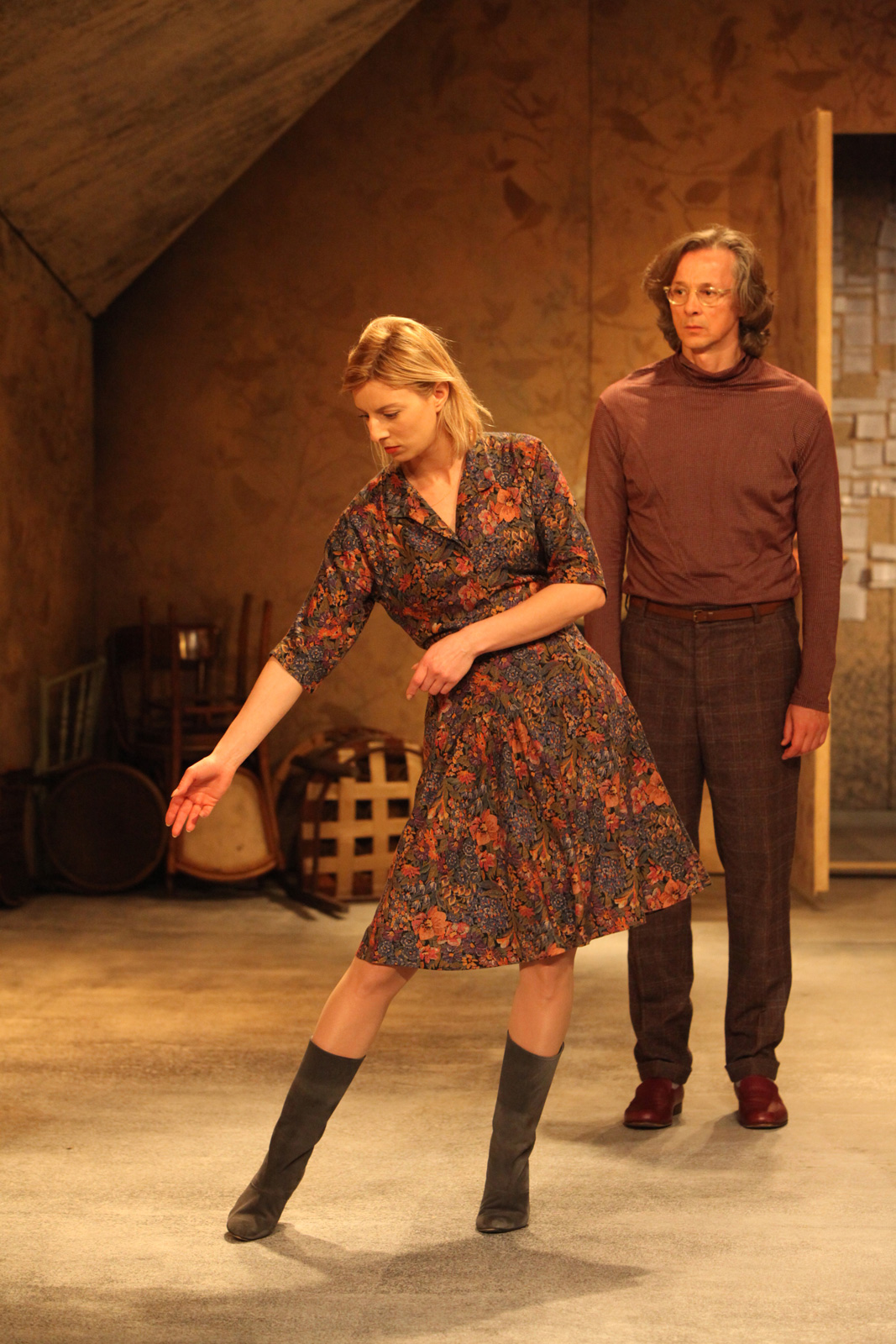
In We are Kings not Humans, whose title is also a result of contingency, of a children’s play, Ferlin presents a captivating theatre per se in which lucidity emerges from (deep) within the layers of language. This exploration not only allows adults to re-discover the purity of their own, once achievable but now forgotten expression, but also highlights an innate wisdom that only children possess. The play's pre-linguistic beyond paves the way for a fresh and profound understanding of oneself, others, the environment, and the world at large. The questions recited by children, then enacted and embodied by actors, vary in their level of concreteness, ranging from more tangible to more theoretical, from being concrete to becoming more abstract, from their full directness to metaphorical questions. But these inquiries do not come from typical textbooks or self-help manuals, nor do they focus on improving one's life directly. Instead, they stem from pure observations of the world around us. As adults attempt to comprehend complex issues, these questions are framed in the most elementary manner, beginning from an essence, where human subjection is structured. How did the world come to be? How are children born? Do you have a lot of friends? What do sad people look like? What is bothering you in life? Despite lacking conventional (dramatic) elements, e.g., distinct dramatic characters, linear storytelling, or a specific time and place of action, the play effectively conveys a narrative through the compilation of children's statements, a simple narrative that delves into how children learn to perceive, how they experience, or how they comprehend the world around them. Even the fundamental classical dramaturgical strategy of ab ovo storytelling is dismantled and purposely simplified, i.e., not using anything excessive, a text is organized into several thematic segments, each starting from the beginning, e.g., creation of the world, animals, and their kingdom, food, education, friendship, love, family, etc. An act of acting is also dismantled and oversimplified, with fixed facial expressions or intonation, as though it is a form of adaptation between two different languages. Moreover, the scenography is proto-Platonic, resembling a (contemporary) cave adorned with peeling wallpapers, e.g., featuring birds, leaves, and branches patterns, instead of prehistoric drawings. However, within this cave, valuable knowledge can be gleaned: the wisdom of the youngest members of society. According to Kleist’s Herr C., theatre art “would be better off without human performers”. One could easily add, it would be better off with more children as well. Adult performers in We are Kings not Humans, as alluded by the author’s team, almost behave like “hidden mothers” - ordinary mothers that were employed to make children still on Victorian photos, because of long exposure time required by the photographic equipment of the time and short attention span of those days, as well as todays’ children. Nevertheless, Antonin Artaud’s vision of performance did not require these “hidden mothers”: he was his own mother, his own father. And same applies for theatrical reality reconstituted in, both, Sad Sam Almost 6 and We are Kings not Humans, where children’s languages, speech acts and voices are, indeed, more than capable of producing their own, “clear” realities.
PHOTOS BY MARA BRATOŠ



was presented at :
2016
Marulićevi dani, Croatian National Theatre Split, HR
April 2016
TESZT Festival, Timisoara, RO
May 2016
2015
Kunstenfestivaldesartes, Brussels, BE
May 2015
Mittelfest, Cividale, IT
July 2015
Bitef festival, Belgrade, RS
September 2015
Cultural Centre Travno, Zagreb, HR
September & October 2015
MESS Festival, Sarajevo, BA
October 2015
Istrian National Theatre Pula, HR
October 2015
2015–2016
Croatian National Theatre, Zagreb, HR
May 2015 – May 2016