Staging a Play: Glass Menagerie 2 0 1 5

STAGING A PLAY: GLASS MENAGERIE . Concept, direction Matija Ferlin . Performance, choreography Loup Abramovici . Anja Bornšek . Maja Delak . Matija Ferlin . Žiga Krajnčan . Dramaturgy Goran Ferčec
. Stage design Mauricio Ferlin . Music Luka Prinčič . Costume design Matija Ferlin . Light design, technical direction Saša Fistrić . Production & partners Emanat . Matija Ferlin . Bunker — The Old Power Station — Elektro
Ljubljana . Mediterranean Dance Center . Pre-School Education and
Grammar School Ljubljana
Read more
Staging a Play: The Glass Menagerie opts for a different approach to Tennessee Williams’ play deconstructing a voice operated intention in performance, therefore creating a space for embodied and physically non-determined stage statements to re-appear, interiorized, as well as led by an author’s own concept of “memory play”, where the scene is non-realistic, poetic, omitting certain details, emphasizing, or exaggerating others, depending on the emotional immanence eager to explore and manifest on the stage. Williams’ play is full of paratexts, stage directions are crucial for its understanding, and even for most of the characters’ development. This paratextual tissue functions as a predetermined script and can easily be interpreted as an instruction for the moving body. Language cancelation that Ferlin eagerly employs, brings forth those elements of the play, or its dramaturgy, that would usually be set aside, put in the background, as an ill-employed mise-en-scène, in order for the idea of staging procedure starts to precede that what is about to be performed. A signifying conflict between the lack of speech in the performance, moreover, is not conceived to be a radical deterritorialization of “the voice” into another domain, e.g., onto performers’ bodies, but, quite on the contrary, it is structured as an artistic pursuit for a newly established signifying (or staging) logic where the speech act is directed towards - a choreographic act. Tennessee Williams’ play is not meant to be “a material” for a staging-deconstruction, thus eliminating “graphic” from the choreographic act, but as a background to stage against throughout a seven-part structure, inasmuch as all of the performers’ are able to cope with its density, its anti-mimetic, or non-illustrative material. Stage directions were, moreover, intuitively “transcribed” into different performance tasks, beyond any choreographic intention, somewhere in-between concreteness of the play and blurriness of the synopsis, in an unmarked space where speech is left sustained, thus entering a performative gesture. Ferlin manages to shift the audience’s attention from the employment of space through motion to its creative reshaping, often dismantling canonical stage relations between what is interior and exterior, what is visible and hidden, dynamic and static. In a way, this Staging a Play project, the first one in a row, manages to depict its own stage-reality, using semiotic procedures from everyday life, animation, dance, theatre, in order for the limitations of stage-directing/choreographing cause and effect de-organize itself on-stage, in front of the audience, although in a different form - that of pure (bodily) response to a pre-inscribed task. Moreover, staging procedures explicit in Williams’ play already imply a deeper redistribution and/or suppression of performer-space-interplay. This is why their reemployment cannot function merely as a transposition of one (explicit) performance task into another semiotic system, full of implicit transposing manoeuvres, usually situated far away from habitual theatre practice. Although functioning of the human body, indeed, occurs in an everyday space, the space that the audience perceives in Staging a Play: The Glass Menagerie is a space structured through the sympathetic intuition of the performers’ motions - a space with its own properties, a privileged space, almost like the one in a poem, where conventions are created while its margins are structured. But, in Ferlin’s case, one cannot perceive it as the animation of five bodies on the stage, because their existence in this space is not only temporal, but it depends upon a variety of structurally, aesthetically, or dramaturgically desirable manoeuvres - some of them even being non-doable at all. Hence, staging-space acts here as a repository of signs: in order to hold indifferently the effect of “the script”, Williams’s stage-concept per se, performers are forced to constantly deconstruct architectural relations superimposed to them, deprivileging the centre for the sake of the periphery, or vice versa. This is usually visible through sudden ruptures in the performers’ habitus, almost consistent with their stage-exiting. Almost as though they are able to perform a certain fine-tunning of their own iconicity, they manage to preserve a raw-structure of the overall performance, e.g., they play with their gesture before it is about to be framed by the acting/dancing procedure, their bodies are almost frozen in an explicit stage of pre-performance, and even their costumes are “stuck” in a phase of pre-iconicity (their haircuts being only prepared for putting wigs). This is precisely why dancers/performers are constantly moving, shifting their position inside and outside of the prearranged frame, as well as their relation to it. They are subdued to an intrinsic memory-script - a performative language that eludes speaking, retelling, or narrating a plot, but is all about simply doing. Even if the spectator of the Staging a Play matrix suffers, at least to some extent, from a sort of under-distancing, because the performance’s technicity is being constantly revealed, disclosed, and even dispossessed in front of his eyes, one ought to be aware that an illusion thus created arrives with a certain delay, or even a cadence, while the audience becomes fully acquainted with the fact of not only seeing something, but seeing it as something that stands for something. Staging a Play: The Glass Menagerie is both, a script (or a text) that has acquired its own performative body, and an interplay of spatiality that has become an event. First it resonates as the matrix of different tasks, where each performer illustrates his/her own iconic utterance, before entering a stage/staging arena. Staging a Play: The Glass Menagerie continues to explore the interzone between the abstracted dancing body and the conventions of theatrical, navigating throughout an impossible task where theatre is reinvented anew through the potential of the body, in constant struggle with the text.
PHOTOS BY NADA ŽGANK


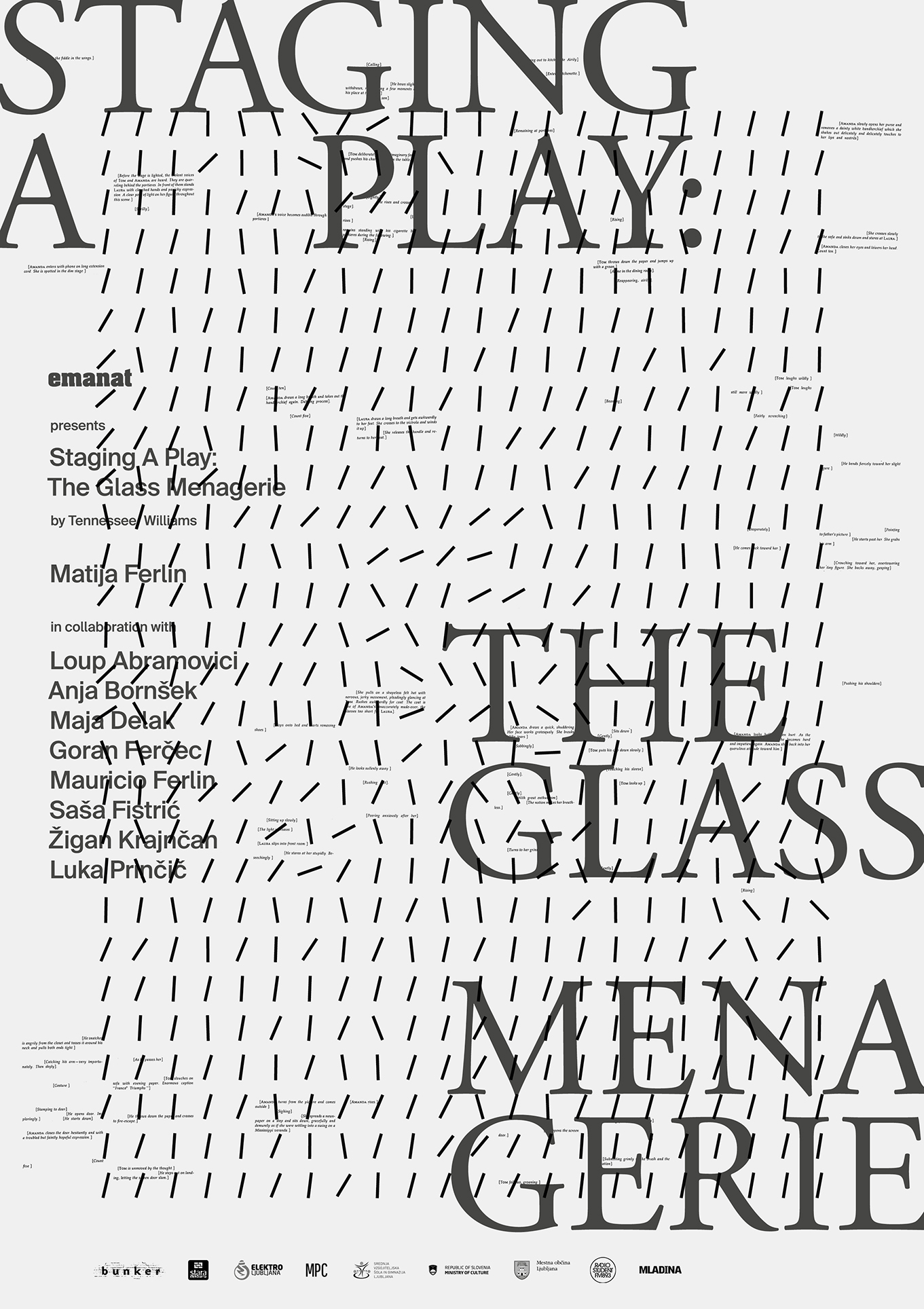
was presented at :
2018
Platforma Festival, Maribor, SI
September 2018
Pelzverkehr, Klagenfurt, AT
October 2018
Slovene National Theatre, Nova Gorica, SI
November 2018
Dance Inn Festival, Zagreb, HR
December 2018
2017
Moving Cake Festival, Ljubljana, SI
March 2017
2016
PUF Festival, Pula, HR
July 2016
Borštnikovo srečanje, Maribor, SI
October 2016
2015–2018
Bunker – The Old Power Station – Elektro Ljubljana, SI
December 2015 - November 2018