Sad Sam Lucky 2 0 1 2
SAD SAM LUCKY . Creation, performance Matija Ferlin . Dramaturgy Goran Ferčec . Poetry Srečko Kosovel . Music Luka Prinčič . Stage design Mauricio Ferlin . Light design Saša Fistrić . Production Recontres chor
éographiques internationales de Seine-Saint-Denis . CND Centre national de la danse . Zagreb Dance Centre . Emanat . Dance & Non-Verbal Theatre Festival San Vincenti
Read more
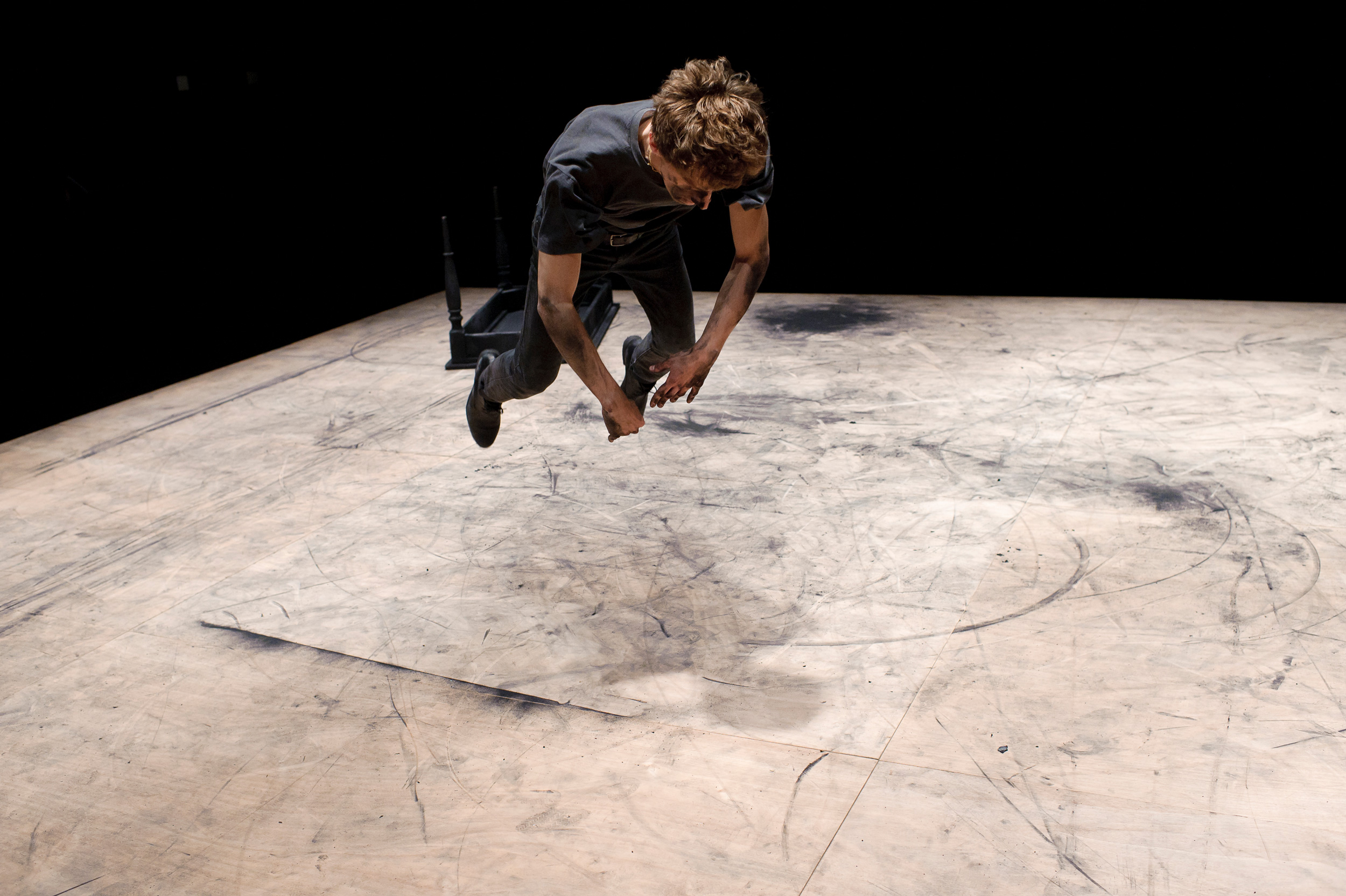
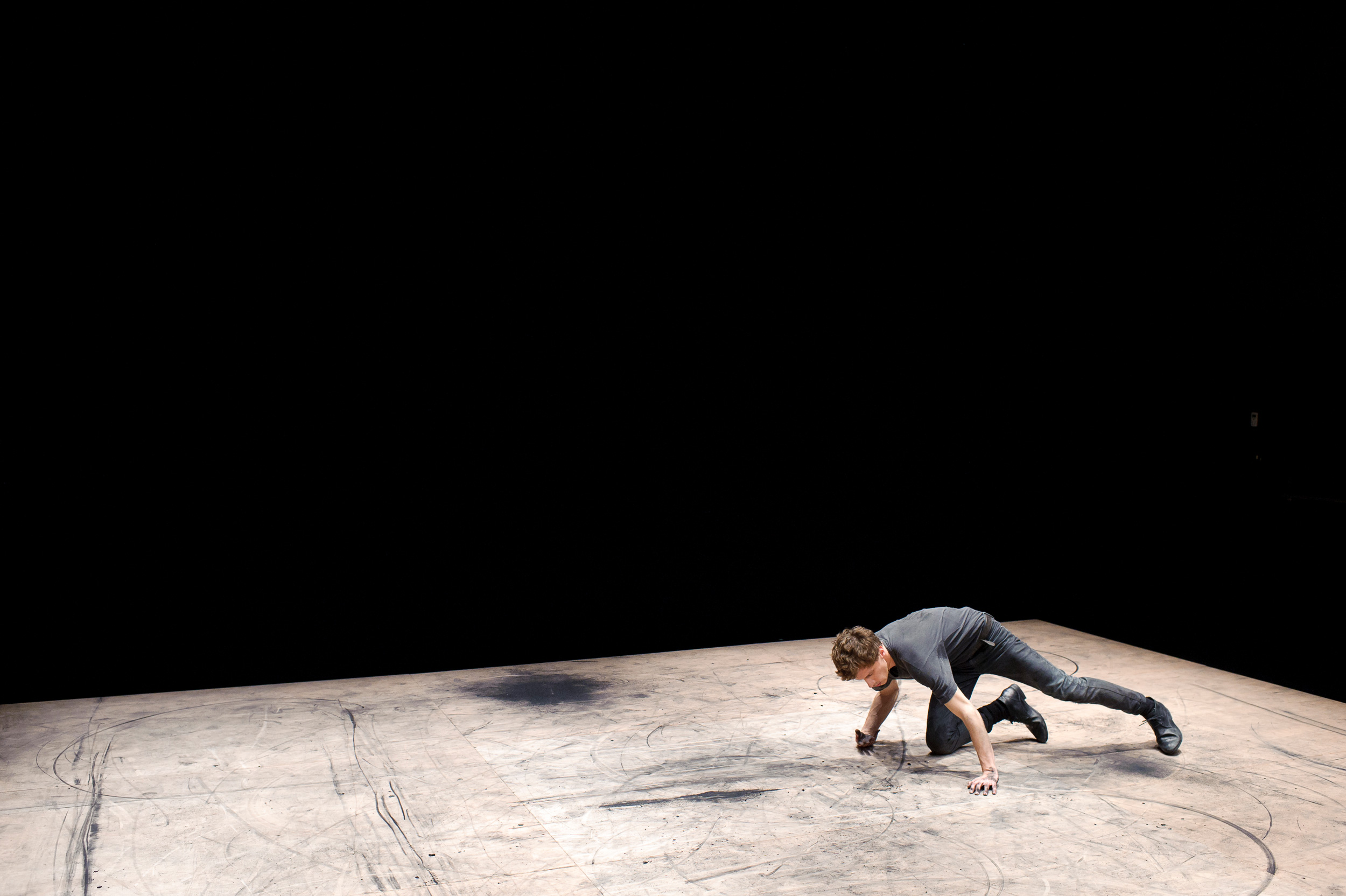
Sad Sam Lucky experiments with language and speech in a similar way. This dance-like imaginary encounter with a Slovenian poet Srečko Kosovel, whose first name evokes “luck” in most South-Slavic idioms, died at the age of just twenty-two in 1926, and is now recognised as a key-figure of European poetic modernity, notably for his poems inspired by impressionism, expressionism and then constructivism. In Sad Sam Lucky, alone on stage, with a writing table and piles of paper as props, Ferlin engages in a physical and turbulent dance of translatability, an invisible conversation and/or simultaneous interpretation guided by the verses of a modernist poet. Two modernisms collide here, as this “intrusion” of choreographed discourse into the field of poetic translation advances on the black, half-empty stage. Somatic or bodily differences between what is said on the scene (English reminiscences on Kosovel’s dramaturgically modified poetry), and what is only choreographed, embodied, or subsumed to movement (i.e., a rigid choreo-text by Ferlin), open and articulate a specific kind of translation politics that commences exactly at the point where resistance of words towards embodiment is to be exploited, looking further than the surface of “staging a play”, or poetry in this case. Dance modernity of this kind ought to be sought in its contingent relation to translation as such, or, to put it differently, in its constant attempt to get rid of textuality choreographically imposed to it, i.e., to recreate its own notion of choreo-graphy, that translates and transmutes “while staging”. Ferlin’s Sad Sam Lucky is not only a physical response to the work of a Slovenian avant-garde poet, a unique hommage to this author, but also an assay to approach his poetry, or its textuality, as well as to distance himself from it, using different dramaturgical tools, most common in poetic translation processes as well, e.g., irony, distancing, wordplays, etc. (“I have a lot to do today. Isn't that cheerful?”). Ferlin constantly abstracts Kosovel's verses out of their immanent content, differing into subjectivity, most personal traumas, etc., therefore intersemiotically “upgrading” it to another level of textual closeness or translator’s honesty. On the stage, it is only dust that rises with each movement. A white floor is surrounded by curtains, closing the space like a black box, representing a room, a capsule, or a piece of paper; smell of incense floats in the air, a few books, and blank pages with indecipherable writing are visible on the floor, which will soon be stapled in turn on the black surface of the table. (Books neatly placed on a performance floor, next to the table, are Kosovel’s oeuvre, with Slovenian edition of Integrals on the top, most visible). Ferlin stands upright, hands blackened, gazes feverishly, often scanning the space in front of him. One sentence is repeated as a motto before every section of the piece, followed by narrated verses, chanted words, anecdotes. Physically navigating between restraint and explosion, between lightness of gestures and the gravity of the body in collision with the ground, with a cyclical structure, performer tirelessly brings us back to the starting point, to this sentence, echoing from a poem by Srečko Kosovel. Dance is, hence, presented as a minoritarian art or performance form - in a way, like poetry inside of the literary realm – so their reality is overwhelmed with contingency, abstractness, and untranslatability, even a “minoritarian” aura in Deleuze’s and Guattari’s sense, as assemblages of the effects or heterogeneous orders of signs, which cannot be reduced to binary structures-of-meaning, or to a dominant or transcendental signifier. Sad Sam Lucky’s intersemioticism, in a way, presupposes at least four languages, or four semiotic systems, whereas three of them are conventional, i.e., Slovenian original of Kosovel’s poetry, its translation to Croatian, its dramaturgical reminiscence in English (by Goran Ferčec), and its somatic (dance-like) choreo-translation. Traces of Kosovel’s poetry are, thus, mediatized through all of the aspects of the Sad Sam Lucky performance, e.g., vocally articulated, “danced”, physically present on the paper, as props, books, etc. Material becomes persistent in exposing its own origin, depicting its own traceability, in a sense of Deleuzian repetition. Interestingly, intersemiotic translation procedures are consistently designated by different performative strategies: at first, Kosovel’s words resonate with restraint, the motionless body, concentrating all the intensity of the subject in his voice, then they are suddenly transferred to a second voice, superimposed, more intimate, halfway through the piece, where he narrates parts of his life, tells anecdotes that make the public laugh, together with bestial cries, as they are finally embodied, subordinated to a strong image of a young poet (dancer’s disembodied body) in a duet with the wooden table.
PHOTOS BY DANKO STJEPANOVIĆ . POSTER ARTWORK BY CHRISTOPHE CHEMIN


was presented at :
2024
Istrian National Theatre, Pula, HR
April 2024
2023
KMD, Dubrovnik, HR
December 2023
2022
Antisezona 22 - MSU, Zagreb, HR
June 2022
CND - Pantin, Paris, FR
June 2022
Bunker - The Old Power Station – Elektro Ljubljana, SI
March 2022
2017
CSS Teatro stabile di innovazione del FVG, Udine, IT
January 2017
Periscope Festival, Rijeka, HR
October 2017
2016
Monoplay Festival, Zadar, HR
August 2016
BAD Festival, Bilbao, ES
October 2016
2015
Nagib na oder, Maribor, SI
June 2015
Croatian National Theatre Varaždin, HR
June 2015
MESS Festival, Sarajevo, BA
October 2015
Dance2eleven, Klagenfurt, AT
November 2015
2014
Onassis Cultural Centre, Athens, GR
March 2014
Uovo Festival, Milan, IT
March 2014
Istrian National Theatre, Pula, HR
April 2014
FTA - Festival TransAmériques, Montreal, CA
May 2014
IKS festival, Split, HR
June 2014
Zero Point Festival, Prague, CZ
July 2014
2013
Kunstenfestivaldesarts, Brussels, BE
May 2013
Black Box Theater, Oslo, NO
March 2013
Infant, Novi Sad, RS
June 2013
Tiger Dublin Fringe, Dublin, IE
September 2013
Actoral, Marseille, FR
September 2013 & January 2016
2012
Zagreb Dance Centre, Zagreb, HR
April & October 2012
Rencontres chorégraphiques internationales de Seine-Saint-Denis, Paris, FR
May 2012
Dance & Non-Verbal Theatre Festival San Vincenti, Svetvinčenat, HR
July 2012
2012–2014
Bunker - The Old Power Station – Elektro Ljubljana, SI
April 2012 – January 2014