Sad Sam Almost 6 2 0 0 9
SAD SAM ALMOST 6 . Creation, performance Matija Ferlin . Dramaturgy Katja Praznik . Stage design Matija Ferlin . Silvio Živković . Light design Urška Vohar . Production & partners Emanat . Matija Ferlin . Chez Buswick . Bunker — The Old Power Station — Elektro Ljubljana . Istrian National Theatre — Pula City Theatre . Tanzquartier Wien
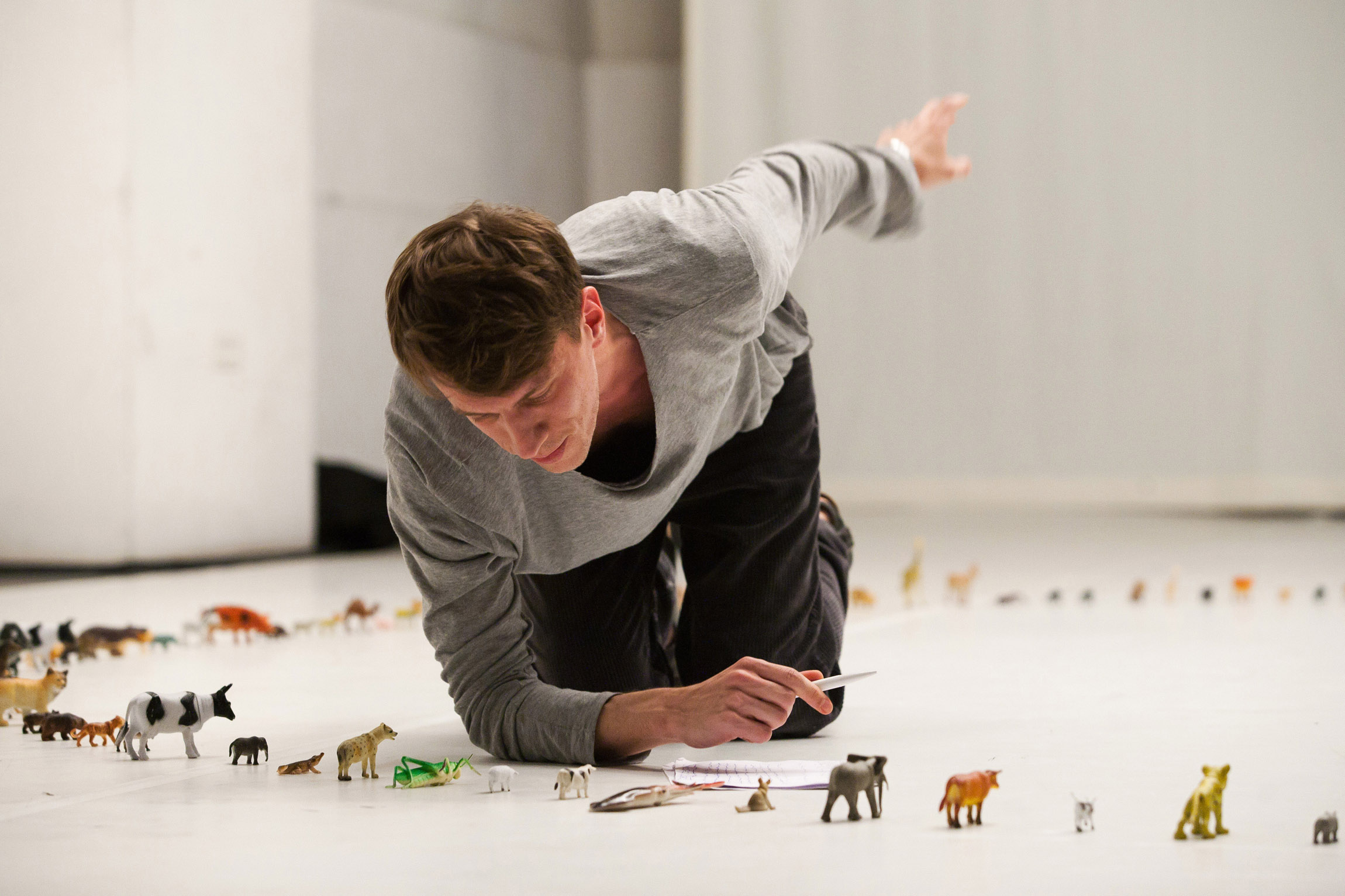
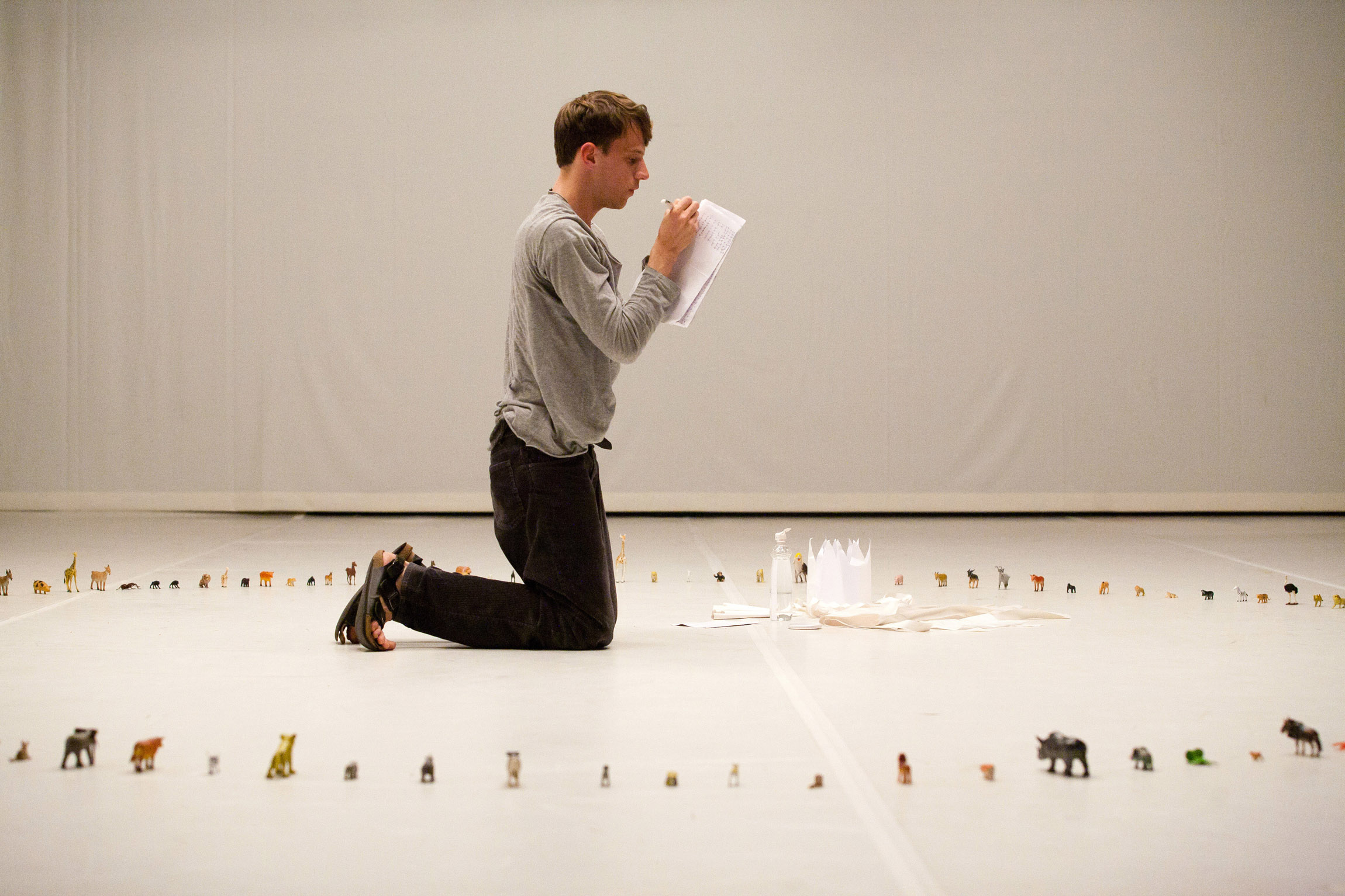
In his solo performance Sad Sam Almost 6 Matija Ferlin wants to investigate a mind of a child, not pre-conditioned by anything social, political, and cultural, not determined by language, fully emancipated, decontaminated even from its own existence. Thus, this performance is eager to narrate a story of a Bildungs-process, of growing up, whereas numerous “terrorizing” facts solely creates obstacles for emancipation, repeatedly rearranging different social conditions and constraints in a contingent way. All fictional childhood characters are presented as enemies, and the overall process of growing up merely stipulates these imperfections, that will consequentially make our lives, singular, specific, individual, and even unique. Matija Ferlin and Katja Praznik created different axioms, reflecting the nature of this singularity: “A child with no fear! The mind of a kid being conditioned (if at all) only by its existence. Grow up and kiss terror! The (in)capacity to stop the social terror that transforms childhood naivety into fear of a grown man”. Singularity, in this case, is created not only by Ferlin’s meaningful, semantically interwoven relationship with the props, the figurines, a relation which can be understood as child play but at the same time, as well, as an ironic criticism of different hegemonic discourses, of mastery, or of positions within different spiritual groups, or various contemporary pedagogies, often responsible for indoctrinating, while concealing their ideologized background, without any conceptual logic behind its construct of “the truth”. The emancipatory potency that is being presented her is, moreover, not only that of “a child” – placed in a circle, surrounded by different animal figurines, the performer’s illusionary community of followers – but also that of “self-presence”, where the performer functions as an intriguing-machine, curious device for gradual abolition of a gulf between the hegemonizing subject and its subordinated ignoramuses. Moreover, Ferlin’s performer, or Ferlin-as-a-performer, produces a fictional consciousness that is repeatedly being disclosed in front of the audience – in a form that has more to do with a conventional monodrama, then dance – while the precise form of an overall narrative, as well as the persuasive suggestibility of a solo-performer on the stage, leave the impression that the figurines are alive. This type of community retells different social, emotional, and intellectual adventures, totally aware that as long as spectators are assembled in this mystical performance space, the living, sincere, communitarian essence of an open dialogue between a childlike fiction and a world of adults is preserved. Notably, as the process of theatre-like communication is established, the privileges usually embedded to performers in this process are simultaneously deconstructed, leaving a specific model of “performative democracy” behind. Sad Sam Almost 6 enacts a community that eagerly employs the metaphoric potency of mysticism as well, a child’s immanence in partaking of the divine life, which is innocent and pure. A solo performer continuously enacts child’s pranks without any virtuosity, which he also eliminates in one of the afore mentioned axioms. He engages in choreographically and performatively non-elaborated, but pre-structured games, and these plot-elements of a rudimentary sort deconstruct a quasi-childish stage innocence. Instead, they exude an eerie ironic undertone, by emulating intricate complexities of the adult(hood). The audience cannot escape the feeling that there is someone else on the stage, that the performer, Matija Ferlin, is just seemingly (performing) alone. His performance clearly navigates through constant re-appearing and dis-appearing of a naive, innocent child, nevertheless, oscillating between amusement and dread, while shedding a different light on the profound significance of early childhood experiences in shaping one's identity. In this sense, adult’s care becomes an oikonomia of different social and political relations, with clearly indicated source of power. Although this play ultimately becomes a multidimensional artistic endeavour, encouraging introspection into the intricate interplay of personal emotions and social dynamics, also resonating with performance realms that negotiate ideologies, it stays accessible and all-engaging, i.e., its playful infantilism is radical in a sense that it carnivalizes and transgresses the liminality which is usually attributed to a child-adult-becoming. Sad Sam Almost 6, moreover, raises important questions about teaching spirituality alongside with physical expressiveness. It delves into a complex procedure of forming a circle of followers, arguing that most of the tools for navigating various, allegedly tailor-made educational environments, where open knowledge becomes a rather formulaic how-to, without room for discussion, are not only often empty and inconsistent, but purely hegemonic in nature. Only a handful of children escape this prison-house of pedagogic discourse, and only one little horse manages to step out of the closed circle of obedience. When the circle of ill-conceived trust is broken, even the performer, an all-mighty lecturer, briefly escapes his role, sharing with the audience a childhood memory of running freely through his vineyard in Istria. Interestingly, this nostalgic misperformance of freedom leaves a more profound impact than everything occurring within the circle, e.g., even suggesting that an entire artistic life may be built upon singularity, and contingency, or constructed from ecstatic moments of freedom, rather than years of professional academic development. Drawing inspiration from the emancipatory potency of children’s language, as well as from a theatrical medium that follows the logic of their speech - perceived as a performative act – like in Sad Sam Almost 6, the author tries to examine the role of children misbehaving and misperforming, which is often a by-product of their education and emergence into the world of adults.
PHOTOS BY NADA ŽGANK


was presented at :
2022
Mot Festival, Skopje, FYROM
November 2022
2021
SMEEL, Ljubljana, SI
November 2021
2020
Croatian Cultural Center Sušak, Rijeka, HR
September 2020
2017
CSS Teatro stabile di innovazione del FVG, Udine, IT
January 2017
2015
Centre Pompidou, Paris, FR
May 2015
Zagreb Dance Centre, Zagreb, HR
May 2015
The Zero Point, Prague, CZ
July 2015
We Are Human Festival, Verona, IT
September 2015
NAOcrea, Milano, IT
December 2015
2014
FTA - Festival TransAmériques, Montreal, CA
May 2014
2013
Teatro Studio, Firenze, IT
March 2013
TAP - Théâtre Auditorium de Poitiers, FR
April 2013
La Bâtie-Festival, Genève, CH
September 2013
2012
Dansfabrik, Le Quartz, Scene National, Brest, FR
March 2012
Black Box, Oslo, NO
March 2012
Le Centre chorégraphique national de Caen en Normandie, Caen, FRMay 2012
Santarcangelo Festival, Santarcangelo, IT
July 2012
Le Colombier, Bagnolet, FR
November 2012
DANSEM 2012, Marseilles, FR
November 2012
2011
Moving Cake Festival, Kino Šiška, Ljubljana, SI
February 2011
Balkan Dance Platform, SMEEL, Ljubljana, SI
April 2011
Museum of Contemporary Art, Croatian Choreographic Platform, Zagreb, HR
June 2011
2010
X-YU Festival, The Dixon Place, New York, US
May 2010
Dance Theatre Ljubljana, SI
September 2010
Museum of Contemporary Art, Platform of Young Choreographers, Zagreb, HR
October 2010
Kondenz Festival, Station, Belgrade, RS
October 2010
2009
Bunker - The Old Power Station – Elektro Ljubljana, SI
January 2009
Istrian National Theatre, Pula, HR
April 2009